Monday, June 24, 2013
Thursday, June 20, 2013
What Motivates Photojournalists?
Denis Reggie
Denis Reggie is one of the most famous wedding photographers.
Born in Crowley Louisiana he has been always interested in photography. After
college while attending his ex-girlfriend’s wedding he found himself really
interested in wedding photography. He was really annoyed by the phrase “Look
here and smile” when photographers tried to take a photo of the couple. He
realized that there is a better way of getting that natural feeling from the
couple and he set a goal to find out how to capture that natural joy of love
with his camera. He later on went to reinvent the whole purpose of wedding
photography and rebuilt characteristics of capturing those perfect images.
Denis Reggie said once in an interview “The thing that motivates me the most in
wedding photography is the smile on the faces of the happy couple, and my job
is to capture that.”
Image
By: Denis ReggieImage
Source: http://www.denisreggie.me/2010/388/
Nick Brandt
Nick Brandt is a famous landscape photographer. He was
born in 1966 in England. He became very interested in East African wildlife and
dedicated his whole photography career to capturing those grandeur photos of African
animals. He studied a lot about illegal hunting in Africa and all the animals
that were destroyed illegally. His main goal and motivation of his life became
to capture those “last stands” of the animals in their natural environment before
they were either captured by zookeepers or killed by hunters. He fought a lot
to prevent the illegal killing and his camera was his main weapon. He created a
lot of photographic exhibitions to show how gorgeous animals of Africa were
killed left and right causing many animals to go extinct. The beauty of the animals
and nature is also one of my main motivations. I love nature and love animals
so capturing these beautiful creatures is what I am passionate about.
Image
By: Nick Brandt
Image Source: http://nicksmithphoto.wordpress.com/tag/photographer/
Image
By: Nick Brandt
Image Source: http://sol-scphotography.blogspot.com/2010/05/nick-brandt.html
Pete Souza
Another famous photographer in United States is Pete
Souza. His is the main photojournalists in the White House and the official
photographer of President Barack Obama. He is probably the closest person to
the president because he is right there with him whenever he is at work. He
even gets to shoot some of his private photos of his family life. Pete is
always present during all his meeting with different officials and White House
events such as picnics, balls and outings. His motivation of photojournalist
career is to capture the true life and character of the most famous man in
United States. His photographs is what people see all around the world so his
main job is to create photos in such a way to keep the president in positive
light in the eyes of people of United States and around the world.
Image
by: Larry Hamel-Lambert
Image Source: https://twitter.com/petesouza

Image
By: Pete Souza
Image Source: http://www.photography-collection.com/photographers/pete-souza-photographs-barack-obama-in-private-moments/
My Motivations!
Sunday, June 16, 2013
Photojournalism and Bias
“Going Home”
Photo by: Ed ClarkImage Source: http://www.thegreatleapsideways.com/?p=209
Subject’s
Expression: The
expression of the main subject is sad so it creates the mood for the photo as
though something bad had happened.
Obvious
Main Subject: The
main subject takes up about 2/3 of the photo making it the first thing that
viewer sees.
Rule of
Thirds:
The main subject is in the left third of the photo making it the main subject.
My interpretation
of the photo is that this shot by Ed Clark does a very amazing job opening up
the true feelings and emotions that are present at a funeral. The main subject
the photo a shipman Graham Jackson is crying and is looking up on the train
parade which is bringing the body of Franklin D. Roosevelt. His is looking up
probably because he considered Franklin D. Roosevelt as his hero and he was
probably looking up to him his whole life so now even after his death Graham
still looks up to him only with tears of remorse that he passed away.
Truth
Photo by: UnknownImage Source: http://www.reuters.com/article/2007/05/29/us-russia-beslan-idUSL2973589920070529
Texture:
The
texture of the concrete walls that once made up the walls of the schools is all
broken up and very rough creating a sense that there was a fierce battle inside
those walls.
Depth
of field: The
whole photo is in focus so everything from the lady to the photos on the wall
is important for viewer to see.
Use of
Lines: The
grid lines from the photo edges that are posted on the wall create a very
organized way of displaying the photos of people who died and respects them.
Not Truth
Image by: UnknownImage Source: http://unitedpatriotsworldwide.com/vinienco/2012/page/2/?w=18
Exposure
Time: The
shutter speed that was used was fast so it captured that specific moment—freeze-frame
Quality
of Light: The
light shines directly on their faces and captures that true expression.
Color
or B&W: This photo is in color so the color brings out
the vivid details of the photo.
I think this photo does not represent truth
to me because it is bias. The reason why I think this photo is bias is because
it presents Muslim people in this light of violence, terrorism, and extreme
anger. Searching for a photo online I typed “Muslim” in Google search and most
of the photos that came up were of Middle Eastern people with machine guns in
their hands and masks on their faces. I think that this is not true at all.
Many photojournalists photograph few Muslim extremists and readers of magazine
and newspapers think that all Muslims are violent which is not true. I know
many Muslim people who are the nicest and kindest people that I have ever met
in my life. It all depends on the bias opinion of the photographer.
Friday, June 14, 2013
The Ethics of Photojournalism
Just like any other career or activity, photojournalism
has its own set of ethical rules that all photojournalists follow. One of the
important governing bodies in the photojournalist career is National
Press Photographers Association Code of Ethics. This is a set of written rules of ethics that each photojournalist
should follow if they want to keep their job as a photographer. One of the rules
on the Code of Ethics is “Editing should maintain the integrity of the
photographic images' content and context. Do not manipulate images or add or
alter sound in any way that can mislead viewers or misrepresent subjects.”
Basically what this means is that when a photojournalist edits his or her
photos with Photoshop or any other photo editing software they should consider
the fact that the information presented in the picture cannot be altered and
the details of the photo cannot be changed.
One of the most recent
examples when the NPPA Code of Ethics was now followed was in a photo taken by John
Tlumacki. John is one the photojournalists who works for The Boston Globe. He was present at the scene of the recent Boston
marathon bombings in April of 2013. During his news gathering there he took a
photo of an injured women lying on the road. The original photo (left) shows
all the details and horror of the bombings. The photo shows that a woman is severely
injured and part of her leg along with her pants is missing. The editor at The Boston Globe thought that the image was too dramatic and horrific for the
readers of the paper to see, so they edited the photo and resulted in the photo
on the right. In the edited photo they manipulated the detail of the photo by
removing the wound from the leg and covering with pants. This photo raised a
lot of controversy among photojournalists and people who found out about the edited
photo.
Photo By: John Tlumacki
Image Source: http://miapappalardojournalismehtics.wordpress.com/2013/04/22/daily-news-doctored-front-page-photo-from-boston-bombing/
One of the good
questions to ask is “What would I do if I was in the situation that John was in?”
One of the ethical values that I have on my map is honesty. I think that one of
the most important qualities in the person is honesty. I like it a lot when
other people are honest with me and also I try to be always honest with them. I
think that there is a lot less conflicts and problems between people when they
are honest to each other. When people tell the truth right away to each other
even if it is the bad truth it could be the way to solve the conflict. In John’s
case what I would do is keep the photo the way it was taken. I think in order
for a photographer to be honest he or she has to keep the details of the photo.
It is important for the viewers to see exactly what happened so the photos
cannot be manipulated.
Tuesday, June 11, 2013
Trials and Triumphs of Women Photojournalists
Females have always been discriminated against in many fields of work and life. Ever since ancient history women had fewer rights then man and were considered subordinate to men. In most countries around the world and even in US women were considered to be housewives whose job was to raise the children, cook, clean and do all the house work. In many 3rd world countries women have the same fate up to this day. In United States up to middle of 20th century women did not have many rights. They could not vote, they could not hold any government jobs and when they worked they were getting paid less. Photojournalism is not any different. Many of the female pioneers in the field of photo journalism experiences a lot of discrimination from male colleagues, women, and society. Even though a lot of women photographers were discriminated against, they brought a lot of positive change to the world.
Kate Brooks is an American photojournalist. She was born in
1977. At the age of 20 she started to study Russian language in college while
majoring in photography. Soon she moved to Moscow where she started studying
the lives or Russian orphans living in the outskirts of Moscow. She became so
actively involved in the plight for the orphans that she started a non-profit
aid group in Moscow to help the orphans get on their feet and escape the
horrible conditions of Russian orphanages. Her work was later published in a Human Rights Watch. This article
was named “Abandoned by the State: Cruelty and Neglect
in Russian Orphanages” After this article was published
around the world, this created major reforms in treatments of orphans not only
in Russia, but also in many other countries around the world. Many funds were
opened up and many donations were given to build new orphanages with better
living environment were kids could be raised and have equal opportunities as
the rest of the children.
Kate’s other big field of work was in the Middle East. After
the attacks of 9/11 she went to Pakistan and Afghanistan where she researched
and photographed the impact that US government had on those countries. She was
one of the female photographers who photographed US invasion of Iraq in 2003.
Ever since then she has been freelancing in the Middle East and taking photos
for famous magazines like Time, Newsweek, The New Yorker, and many others. She covered many
political events and disruptions that took place in the Middle East. Some of
her famous and recent works came from the Pakistan Earthquake in 2006, and
Cedar Revolution. Also she is famous for shooting portrait sessions for some
famous Middle East political and military leaders like Pervez Musharraf,
and Hamid
Karzai.
Image Source: https://twitter.com/katebrooksphoto
Subjects
Expression: The subject in the picture takes up most of
the picture so it is the first thing that a viewer notices. The expression of the
subject is very tiring and overwhelmed showing the hard nature of her work.
Keep
it Simple: The simple background allows the viewer to
keep the focus on the main subject and the expression that she portrays.
Does
the Picture remind you of anything: The picture reminds me of the
painting by Leonardo da Vinci of Mona Lisa.
Why I
Choose it? The reason why I chose this photo of Kate Brook was
because it is one of the best close up portraits of herself where she is not
posing but the photo actually reveals the true emotional expression that she
has inside her. The photo shows that she is sad and overwhelmed but the troubles
of life.
Image By: Unknown
Rule
of thirds: The main subject of the picture is Edwin P.
Morrow who is signing the 19th amendment .
Black
and White: The
photo is B&W which helps to create a better clarity of the photo because
the main things on the photo are face expressions and they are in white while
everything else is black.
Use
of Light: Light from the lamp sheds light in the form of a
spotlight to enhance the importance of the signing of the document.
Why?
I chose this photo because I think it was an
important moment for women in their fight for equality because this was when
they finally got the right to vote. This was important moment for them because
it took them a long time and a lot of work to convince the government to draft
and accept 19th amendment to constitution. I like how this photo
shown the proud facial expression of the women because they finally got what
they were fighting for.
Image Source: http://meganmbrown.com/news_clippings.html
In
or out of focus: Even thought the women photographed here are
in different depth of fields they are all in focus showing that they are all
important part of the US military.
Texture:
The texture of the sand and the building
creates a very arid and hot environment of the desert.
Obvious
Main Subject: The main subject takes up about 2/3 of the photo
so it is the first thing that the viewer pays attention to when they look at
the photo.
Why? The
reason I choose the photo was because on this photo there is a group of women
who are serving in the US Military. I think this was a very important step for
women in their fight for equality when they were finally given opportunity to
fight along-side with men and not be nurses and cooks like they used to be in
the past. This photo also shows the proud facial expressions on their faces
because they are proud to serve their country and protect it and they are also
proud to show that they can do it just as good as any man can.
Friday, June 7, 2013
Photography Technology Timeline 1840-2013
Photography Technology has changed so much since 1840
until today. There have been some small changes but a lot of the changes in
technology were so large that they had changed the way photojournalists work
and take pictures. Here are some of the major changes and how they affected
photojournalism.
In 1871 Richard Leach Maddox, invented a gelatin dry
plate silver bromide process. With this process photographers did not have to
develop the negatives right away after they have been processed. Before 1871
the negatives had to be developed right after they were shot otherwise they
were ruined. With an invention of the process it was packaged in containers
like pictured above and each photographer could have his own set.
In 1913 first 35mm camera was introduced to
photographers. This camera allowed film to be put into the camera and pictures
to be taken directly onto the film. This changed photojournalism in many ways. The
cameras became smaller and lighter. They became portable and were more available
for general public to use.
In 1963 Polaroid introduced first color 35mm film. This
allowed for more detailed pictures to be taken by photojournalists. Color added
a lot more detail and life to the photos. Colored photos had more information transferred
to the viewer. Color photos introduced new ideas like advertisements and
billboards with color photos on them to appeal to the senses of targeted
consumers.
In 1984 there was one of largest changes in the history
of photojournalism. This change is still experienced today and influences our
lives in many forms. In 1984 Canon introduced the first digital camera to the
market. There was a lot of research put into the development of a digital
camera and finally in 1984 it was put on sale. As a result of this invention,
film photography started to decline and by today film photography is only limited
to very small amount of people who do it as a hobby. Digital photography allowed
photos to be viewed right after they were taken without developing them. Later on
with invention of internet and wireless transmitters digital photos could be
sent anywhere in the world within an hour.
In 1990 Kodak introduced a new way to store the digital
photos there were taken by their cameras. Kodak figured out a way to store photos
on a CD. This changed the way photojournalists stored their pictures and sent
them to their editors. Also this allowed for a safer way to keep important
photos from being destroyed or mutilated. Any time a photojournalists would
need photo printed, they could access the photo from a CD and print it or send
it anywhere in the world.
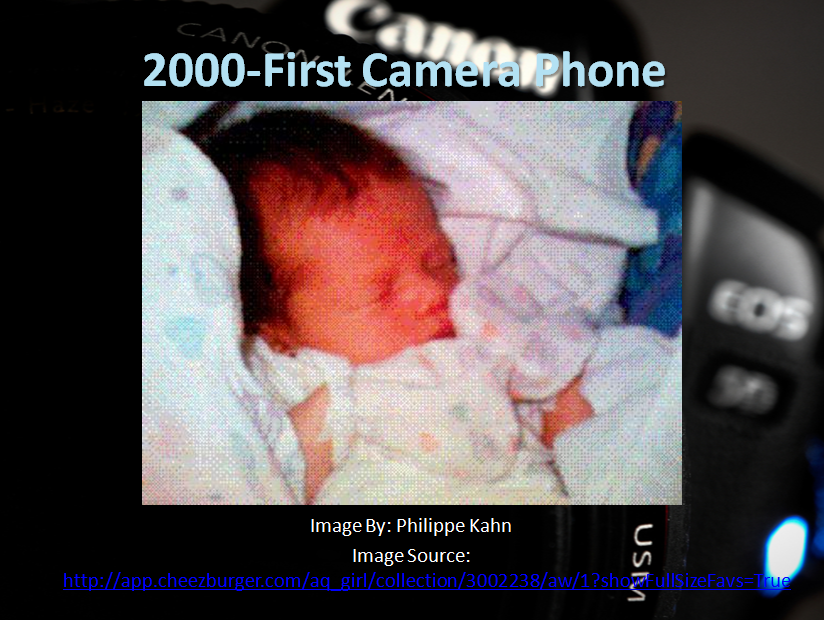
In 2000 Philippe Kahn, attached a small portable digital camera to his Motorola
phone and was able to program it to take pictures with it. This started a new
trend all around the world. Ever since then camera phones became very popular
among both young and old population. Today camera phones are very important
thing that allow people to stay in contact together by exchanging photos and
video chatting. When it is hard to take a large camera, photojournalists often
use their phones to capture photos and then publish them in newspapers and
magazines. Ever since 2000 camera phones became better and more sophisticated.
In 2008 Nikon developed a first camera that could take
videos and still shots. Nikon D80 was the first camera that allowed for a photojournalist
to take video interviews as well as photos with just a switch of a button. This
changed photojournalism careers in such a great way because now they did not
have to bring video cameras and still cameras. Instead they could carry a
camera like canon D80 or later models, or Canon 5D MKII or later models which
allowed them to shoot stills and record videos.
Sunday, June 2, 2013
Chapter 4 - Living in Digital Age
Evolution
of a Camera Phone
Ever since 19th century when cameras were
invented photojournalism has come a long way. Cameras went from being as big as
a wagon to now being so small that they can fit into a cell phone. Digital
photography has been introduced in 1990’s and ever since then photojournalism
evolved the most. First of all, digital cameras are able to take a picture and
display it on a screen on the back of it, so the user can correct the settings
if necessary. These DSLR’s that were used by most photojournalists were still
pretty large and heavy to carry around. In order to send a picture to their
editor they had to use a wireless transmitter to send them. When cell phones
came out, a guy named Philippe Kahn decided to implement a camera into a phone.
These camera phones were such a success that in today’s world almost every
phone has a camera. Many photojournalists shoot some quick photos with their
cell phones.
Image by: Unknown
Image Source: http://www.dailyworldfacts.com/cell-phone-facts/
In 1997, Philippe Kahn had an idea of taking a regular
digital camera and integrating it into the phone. By June of that year when his
wife was ready to deliver his daughter he finished integrating a miniature
camera device into his Motorola cell phone. After his daughter Sophie was born
he used the phone to broadcast the picture of his baby girl to people all
around the world (GSM). Seeing that it was a successful invention and people
loved it, company named LightSurf Technologies became interested in his design.
They soon started to build phones with cameras built into them. The first
camera phone was then released in Japan in 2000. The phone was made by Sharp
and had a name of J-SH04. The first phone was equipped with a CMOS sensor and the
camera was 110,000 pixels. The quality of the images was not the best but that
was a good start (GSM).
Image by: Philippe Kahn
As years passed more and more work was done on research
and development of more compact and better quality cameras that could be used
in cell phone industry. In 2008 Nokia came out with a camera phone that was
able to take pictures of 8 megapixels big. At that time even some of the DSLR
cameras could not produce images of that quality. Today with most of the recent
phones like Samsung Galaxy SIV and iPhone 5 the camera technology is so far
advanced that camera in a phone can be used to make videos, make video
phone-calls. These and many other of the new phones have the ability to create
photos with low aperture and create quality photos even in the dark room. There
has been a few privacy issues involving the cameras on phones, but overall the
invention of a camera phone was a successful project that helps
photojournalists even up to this day when they have to take some fast shots on
the spot and they don’t have their gear with them, or they have to go somewhere
where it would be hard to carry a large camera around.
Subscribe to:
Posts (Atom)